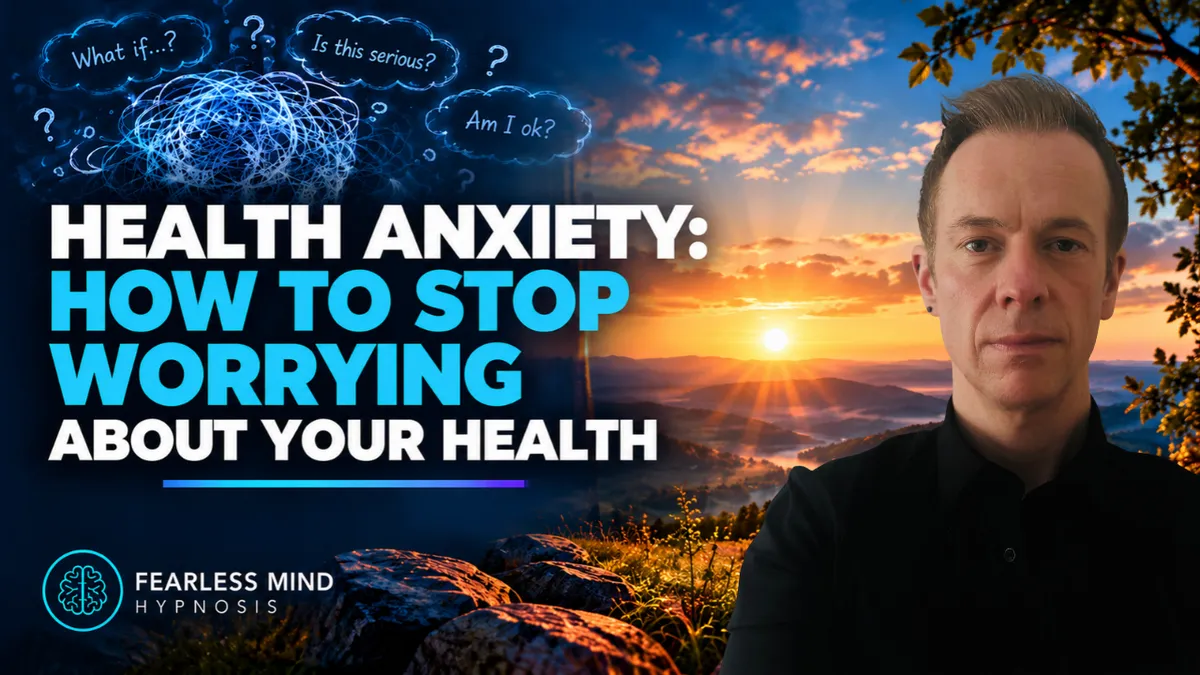
How to Stop Worrying About Your Health | Fearless Mind
Have you ever noticed a strange sensation in your body and immediately started wondering whether something is wrong? Perhaps you feel a slight ache, notice an unusual heartbeat, or become aware of a sensation you haven’t experienced before. Before you know it, your mind is imagining the worst, and you find yourself searching for answers, checking your body, or looking for reassurance.
If this sounds familiar, you may be experiencing health anxiety.
Health anxiety can be exhausting. It can turn ordinary moments into periods of uncertainty and worry, leaving you constantly monitoring your body and questioning whether you’re okay. Even when you’ve received reassurance, the relief can be temporary. Another sensation appears, another question enters your mind, and the cycle starts again.
But what if you could change the way you respond to these thoughts and sensations?
What Is Health Anxiety?
Health anxiety involves persistent worry about the possibility of having a serious illness or developing a medical condition. You might become particularly aware of physical sensations, interpret them as potential signs of illness, or find yourself repeatedly checking your body for changes.
You might search online for explanations, ask other people for reassurance, or spend considerable time thinking about what a particular symptom could mean. Sometimes, you might even avoid medical appointments because you’re frightened of what you might discover.
Although the behaviours can look different from person to person, the underlying experience is often similar: the uncertainty about your health becomes difficult to tolerate, and your mind keeps searching for an answer that will make you feel safe.
The difficulty is that reassurance doesn’t always provide lasting relief. Even when you feel better temporarily, the next unfamiliar sensation or worrying thought can bring the fear straight back.
Why Does Health Anxiety Keep Coming Back?
To understand health anxiety, it helps to look at the cycle that can develop between physical sensations, thoughts, emotions and behaviour.
Imagine you notice a sensation in your body. Perhaps it’s a headache, a muscle twitch or an unfamiliar feeling in your chest.
Initially, it’s simply a sensation. But then your mind begins asking questions.
What if something is wrong?
What if this is a sign of something serious?
What if I’ve missed something important?
As you focus on these possibilities, your anxiety increases. You become more aware of your body, monitoring it for further signs that might confirm your fears.
The increased attention can make sensations more noticeable, while anxiety itself can produce physical symptoms such as muscle tension, dizziness, a racing heart or changes in breathing.
You may then interpret these sensations as further evidence that something is wrong, creating even more anxiety.
This is how the cycle can reinforce itself.
The sensation attracts your attention, the interpretation creates fear, and the fear makes you monitor your body even more closely.
You might respond by checking your symptoms online, seeking reassurance from someone you trust, or repeatedly examining your body. These behaviours can provide temporary relief, but if you come to rely on them every time uncertainty appears, the underlying fear can remain.
Your mind learns that uncertainty is something you must resolve before you can feel safe, and so the search for certainty continues.
Why Reassurance Doesn’t Always Last
One of the most frustrating aspects of health anxiety is that you can know, logically, that your fears may be disproportionate and still struggle to feel reassured.
You might receive a reassuring medical assessment and feel better for a while, only to start worrying again when you notice another sensation.
You might tell yourself that you’ve experienced this before, that the feeling eventually passed, or that you’ve been worrying about the same thing for weeks. Yet the next time the anxiety appears, it can feel just as convincing as it did before.
This happens because understanding something intellectually and changing an automatic emotional response are not necessarily the same thing.
You can recognise that your mind is jumping to conclusions and still feel the urge to investigate. You can understand that repeatedly searching for symptoms makes you more anxious and still find yourself reaching for your phone.
The answer isn’t to criticise yourself for doing these things. It’s to begin developing a different response.
Instead of automatically treating every sensation as a problem that must be solved, you can learn to pause, recognise what’s happening and decide what would genuinely be helpful.
That doesn’t mean ignoring symptoms or assuming that nothing could ever be wrong. New, persistent or concerning symptoms deserve appropriate medical attention.
The goal is to change the relationship between uncertainty and fear, so that anxiety doesn’t automatically dictate what you do next.
How Hypnosis Can Help With Health Anxiety
Hypnosis offers one approach to working with the automatic thought patterns and emotional responses that can contribute to health anxiety.
Rather than simply telling yourself not to worry, hypnosis uses focused attention, imagination and suggestion to help you explore different ways of responding to familiar triggers.
For example, you might practise noticing a thought without immediately following it into a frightening chain of possibilities. You might learn to experience uncertainty without feeling compelled to resolve it immediately. You might also begin to develop a greater sense of choice over where you place your attention.
The aim isn’t to convince yourself that every physical sensation is harmless. It’s to help you respond more thoughtfully, rather than automatically allowing fear to take over.
Hypnosis isn’t a guaranteed solution, and individual experiences vary. However, it can form part of a broader approach to managing health anxiety, alongside appropriate medical care and psychological support where needed.
Try This Free Health Anxiety Hypnosis
I’ve created a hypnosis session specifically for people who find themselves worrying about their health, analysing physical sensations and imagining the worst.
In this session, I’ll guide you through a visualisation designed to help you experience the difference between noticing a sensation and interpreting it as a threat.
You’ll explore how your attention can magnify a worry, how a frightening possibility can begin to feel like a certainty, and how you can develop a different response.
The aim is to help you step back from the constant monitoring and return your attention to the life happening around you.
Find somewhere comfortable where you can listen without interruption. Never listen while driving or doing anything that requires your full attention.
Learning to Live Without Constantly Monitoring Your Health
Overcoming health anxiety doesn’t necessarily mean you’ll never worry about your health again. Everyone experiences uncertainty, and it’s natural to pay attention to changes in your body.
The difference is learning that you don’t have to respond to every worrying thought as though it demands your immediate attention.
You can notice a sensation without immediately deciding what it means. You can recognise a frightening thought without treating it as a fact. You can seek appropriate medical advice when necessary without spending the rest of your day searching for reassurance.
And when there is nothing more useful to do, you can return your attention to the things that matter to you.
Your relationships. Your work. Your interests. The ordinary moments that make up your life.
Because your life is bigger than the things you worry about.
You can look after your health without living in fear of your health.
When to Seek Additional Support
If health anxiety is taking up a significant amount of your time, affecting your relationships or making it difficult to enjoy everyday life, you don’t have to manage it alone.
A GP or qualified mental health professional can help you understand the support available. Cognitive behavioural therapy (CBT) is one established treatment for health anxiety, and other approaches may also be appropriate depending on your circumstances.
If you’re experiencing new or concerning physical symptoms, seek appropriate medical advice rather than assuming they’re caused by anxiety.
Hypnosis can be explored alongside other support, but it shouldn’t replace medical assessment or necessary treatment.
Take the First Step Towards Change
I’m Andy Robson, a hypnotherapist in Shawlands, in the Southside of Glasgow. I help people work towards changing the patterns that keep them feeling stuck.
I know how exhausting anxiety can be. I spent more than a decade struggling with it myself before working with a hypnotherapist helped me change my life in ways I hadn’t thought possible.
Today, I use my own experience alongside my hypnotherapy training to help others develop a different relationship with anxiety and move towards the lives they want to live.
If health anxiety is affecting your life and you’d like to explore whether working together might help, you can book a free consultation.
We can talk about what you’ve been experiencing, what you’d like to change, and whether hypnotherapy is an appropriate option for you.
You don’t have to wait until you feel completely certain or completely ready before taking the first step.
Sometimes, change begins with being open to the possibility that things can be different.