How to Stop Panic Attacks: Understanding Panic and How to Regain Control
Have you ever experienced a sudden wave of intense fear that seems to come out of nowhere? Perhaps your heart starts racing, your breathing changes, you feel dizzy or lightheaded, or you suddenly become convinced that something terrible is about to happen.
You might know, logically, that you’re not in any obvious danger, but your body seems to be telling you something completely different.
Panic attacks can be frightening, particularly when you don’t understand what’s happening. And if you’ve experienced them more than once, you might find yourself worrying about when the next one will strike.
You may start avoiding certain places or situations. You might become more aware of your heartbeat, your breathing or other physical sensations. Perhaps you find yourself constantly checking how you feel, wondering whether that familiar wave of panic is about to return.
Before long, the fear of having another panic attack can begin to affect your life almost as much as the attacks themselves.
But understanding what’s happening can be an important first step towards changing your relationship with panic.
What Does a Panic Attack Feel Like?
Panic attacks can affect people in different ways, but they often involve a sudden surge of intense fear or discomfort accompanied by physical and psychological symptoms.
These can include:
A racing or pounding heartbeat.
Shortness of breath or a feeling that you cannot get enough air.
Dizziness or lightheadedness.
Sweating, trembling or shaking.
Tightness or discomfort in the chest.
Nausea or an unsettled stomach.
Feeling detached from yourself or your surroundings.
A fear of losing control, fainting or dying.
The experience can be overwhelming, particularly if you don’t understand why it’s happening.
Some people experience panic attacks in specific situations, such as driving, travelling, being in crowded places or speaking in front of others. For others, they seem to appear without warning.
One of the most difficult aspects of panic is that the physical sensations can feel so convincing. When your heart is racing or your breathing feels different, it’s understandable that your mind might start searching for an explanation.
And when that explanation involves danger, the fear can intensify.
If you experience new, severe or unusual physical symptoms, don’t automatically assume they’re caused by panic. Seek appropriate medical advice, and contact emergency services for symptoms that may indicate an emergency.
Once you’ve had appropriate medical assessment, understanding how panic works can help you explore ways of responding to it differently.
Why Do Panic Attacks Happen?
To understand panic, it helps to understand the body’s natural threat response.
Your nervous system is designed to help you respond to danger. When your brain perceives a threat, it can prepare your body to act. Your heart may beat faster, your breathing may change, and you may become more alert to what’s happening around you.
This response can be useful when you need to deal with a genuine threat.
The difficulty is that the body’s alarm response can also activate when there isn’t an obvious external danger. Stress, anxious thoughts, physical sensations and other factors can contribute to this happening.
When the resulting sensations are interpreted as evidence that something terrible is happening, the experience can escalate.
For example, you might notice your heart beating faster than usual. You become concerned that something is wrong, which makes you more anxious. Your anxiety increases your heart rate further, making you even more concerned.
Before long, you’re caught in a cycle that can feel impossible to escape.
This is one reason panic attacks can become so frightening: the physical sensations trigger fear, and the fear can intensify the physical sensations.
Understanding that cycle gives you somewhere to begin.
The Panic Cycle: Why the Fear Can Keep Coming Back
Imagine you’re sitting in a café when you suddenly notice your heart beating faster.
At first, it’s simply a physical sensation. But then a thought appears.
What’s happening to me?
You begin paying closer attention to your heartbeat. You notice every change, and your mind starts imagining possible explanations.
What if something is seriously wrong?
What if I lose control?
What if I have a panic attack here?
Your anxiety increases. You feel more uncomfortable, which seems to confirm that something must be wrong.
You might leave the café, sit somewhere quiet, seek reassurance or do whatever you believe you need to do to make the feeling stop.
Eventually, the anxiety subsides.
Understandably, you feel relieved.
But your mind may draw a particular conclusion from the experience: I was in danger, and I had to get out of there to be safe.
The next time you notice a similar sensation, you may become frightened more quickly. You might start monitoring your body or avoiding situations where you worry a panic attack could occur.
And so the cycle continues.
This doesn’t mean that leaving a situation is always wrong or that seeking reassurance is inherently unhelpful. It means that, for some people, repeatedly treating panic sensations as signs of imminent danger can strengthen the fear surrounding them.
Over time, the anticipation of panic can become a problem all on its own.
You might start worrying about going to the supermarket, travelling on public transport, driving somewhere unfamiliar or simply being away from home.
Your life can gradually become organised around trying to prevent something that feels terrifying.
But what if there were another way to approach the experience?
Why Fighting Panic Can Make It Harder
When panic strikes, your natural instinct may be to make it stop as quickly as possible.
You might try to force yourself to calm down, repeatedly check your breathing, monitor your heartbeat or search for reassurance that everything is okay.
These responses are understandable. Nobody enjoys feeling frightened or physically uncomfortable.
However, constantly monitoring your internal sensations can make you more aware of them. Interpreting every change as a possible warning sign can also give those sensations greater emotional significance.
You can end up paying so much attention to whether you’re anxious that anxiety becomes the centre of your experience.
You might find yourself thinking:
Am I feeling better yet?
Is my heart slowing down?
What if this gets worse?
What if I can’t cope with this feeling?
And each question can draw your attention back towards the very experience you’re desperate to escape.
The aim isn’t to ignore your body, dismiss genuine concerns or force yourself to tolerate situations that aren’t safe.
It’s to develop a more balanced response to anxiety, so that you don’t automatically interpret every uncomfortable sensation as a catastrophe.
Sometimes, that begins with allowing yourself to pause, notice what’s happening and respond to the situation in front of you rather than becoming caught up in everything you fear might happen next.
How to Stop Being Afraid of Another Panic Attack
For many people, one of the hardest parts of experiencing panic attacks is the fear that another one might happen.
You might feel relatively comfortable at home but become anxious about going somewhere unfamiliar. You may start worrying about being trapped, being unable to get help or having a panic attack in front of other people.
Perhaps you begin cancelling plans or avoiding situations you used to enjoy.
The problem is that the more your life revolves around preventing panic, the more power the possibility of panic can appear to have.
Breaking this pattern doesn’t mean deliberately provoking overwhelming anxiety or forcing yourself into situations before you’re ready.
Instead, it involves gradually building confidence in your ability to respond to difficult feelings and situations.
Depending on your circumstances, this might include learning about the panic response, developing a more balanced relationship with anxious thoughts, and gradually approaching situations you’ve been avoiding with appropriate support.
It can also involve changing the way you think about anxiety itself.
Rather than viewing every anxious moment as evidence that you’re losing control, you can begin to see it as an experience you can respond to, one moment at a time.
You don’t have to guarantee that you’ll never experience anxiety again before you can start living your life more freely.
You can work towards feeling more confident even when some uncertainty remains.
And that can open up possibilities that have felt out of reach for a long time.
Can Hypnosis Help With Panic Attacks?
Hypnosis is one approach that may help some people work on the thoughts, feelings and responses associated with anxiety and panic.
During hypnosis, you enter a state of focused attention in which you can engage with suggestions, imagery and ideas in a different way.
Rather than spending the entire session analysing why you feel anxious, hypnosis can use visualisation and suggestion to help you explore alternative ways of responding to difficult experiences.
For example, a session might focus on helping you feel more capable when anxiety rises, changing the meaning you attach to certain sensations, or imagining yourself responding calmly in situations that have previously felt frightening.
The intention isn’t to convince you that nothing bad can ever happen, or that you should ignore physical symptoms that need medical attention.
It’s to help you develop a different relationship with fear, uncertainty and the possibility of panic.
Hypnosis isn’t a guaranteed cure, and research into its effectiveness specifically for panic disorder is limited compared with the evidence supporting established treatments such as cognitive behavioural therapy (CBT). It may be useful as a complementary approach, depending on the individual and their circumstances.
If panic attacks are significantly affecting your life, consider speaking to your GP or a qualified mental health professional about the support available to you.
You don’t have to work everything out on your own.
Try This Free Hypnosis for Panic Attacks
If you experience panic attacks, or find yourself worrying about when the next one might happen, I’ve created a free hypnosis session to help you begin exploring a different relationship with anxiety.
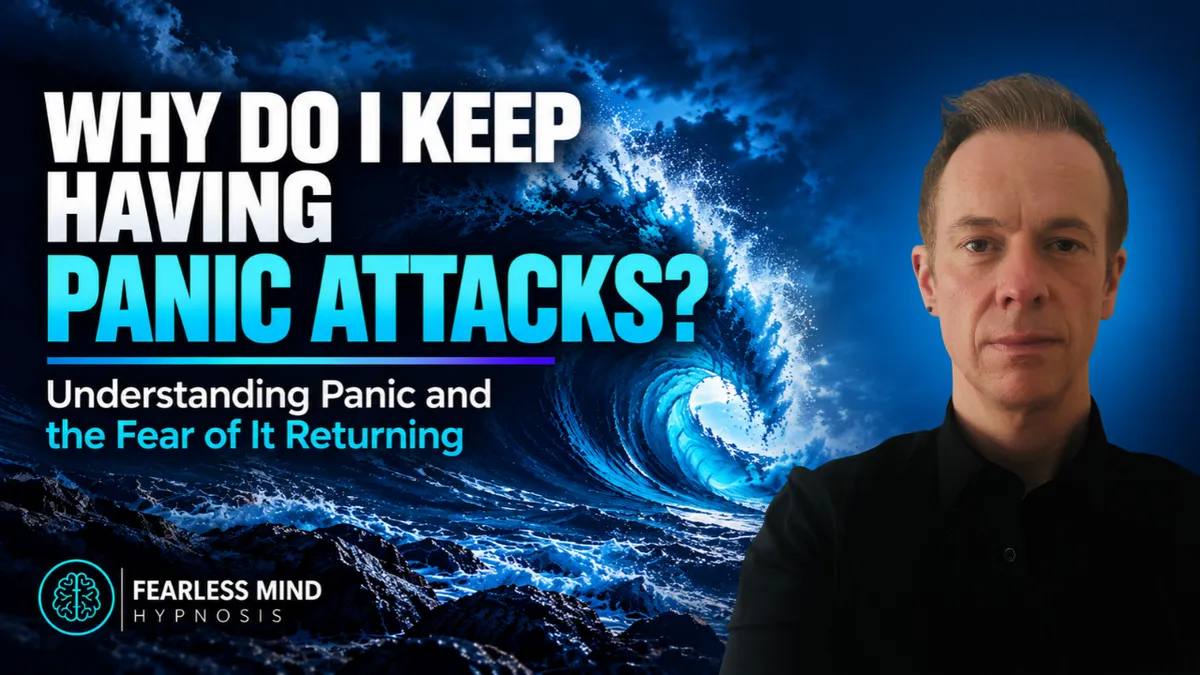
In this session, we’ll use visualisation to explore the experience of panic through the metaphor of a wave.
A wave rises, moves towards the shore and eventually recedes. You don’t have to fight the sea to stand on the shore, and you don’t have to control every movement of the water.
The visualisation explores how you might begin to approach anxious feelings with greater steadiness, rather than automatically becoming frightened of the experience itself.
The aim isn’t to promise that panic will never happen again. It’s to help you develop confidence in your ability to respond when difficult feelings arise.
Find somewhere comfortable, put your headphones on if you have them, and give yourself a few minutes to listen.
Never listen to hypnosis while driving or doing anything that requires your full attention. This recording is intended to support your wellbeing and isn’t a substitute for medical assessment or appropriate mental health treatment.
You Can Learn to Respond to Panic Differently
If you’ve been experiencing panic attacks for a long time, you may have started to believe that this is simply how your life has to be.
Perhaps you’ve tried to reason with yourself, force yourself to calm down or avoid anything that might trigger another attack.
And perhaps you’re exhausted by the constant anticipation of something going wrong.
I understand how consuming anxiety can become. I lived with anxiety myself for more than a decade, and I know what it’s like when fear starts influencing the choices you make.
Working with a hypnotherapist helped me change my relationship with anxiety and ultimately changed the direction of my life. It was one of the reasons I retrained as a hypnotherapist myself.
Today, I help people work towards overcoming the patterns of thought and response that keep them feeling stuck.
Everyone’s experience is different, and there isn’t one approach that works for everyone. But you aren’t necessarily destined to keep responding to anxiety in the same way forever.
With the right support and a willingness to explore new ways of responding, change is possible.
You can begin to rebuild confidence in situations you’ve been avoiding. You can work towards spending less time anticipating panic and more time doing the things that matter to you.
And you can learn that experiencing anxiety doesn’t have to mean surrendering control over your choices.
Looking for Help With Anxiety?
If anxiety or panic attacks are affecting your life, I offer hypnotherapy sessions online and in person in Glasgow designed around your individual circumstances and goals.
We’ll discuss what you’re experiencing, how it’s affecting you and whether hypnotherapy might be an appropriate approach for you.
There’s no obligation to book a session. The first step is simply a conversation about what’s happening and what you’d like to change.