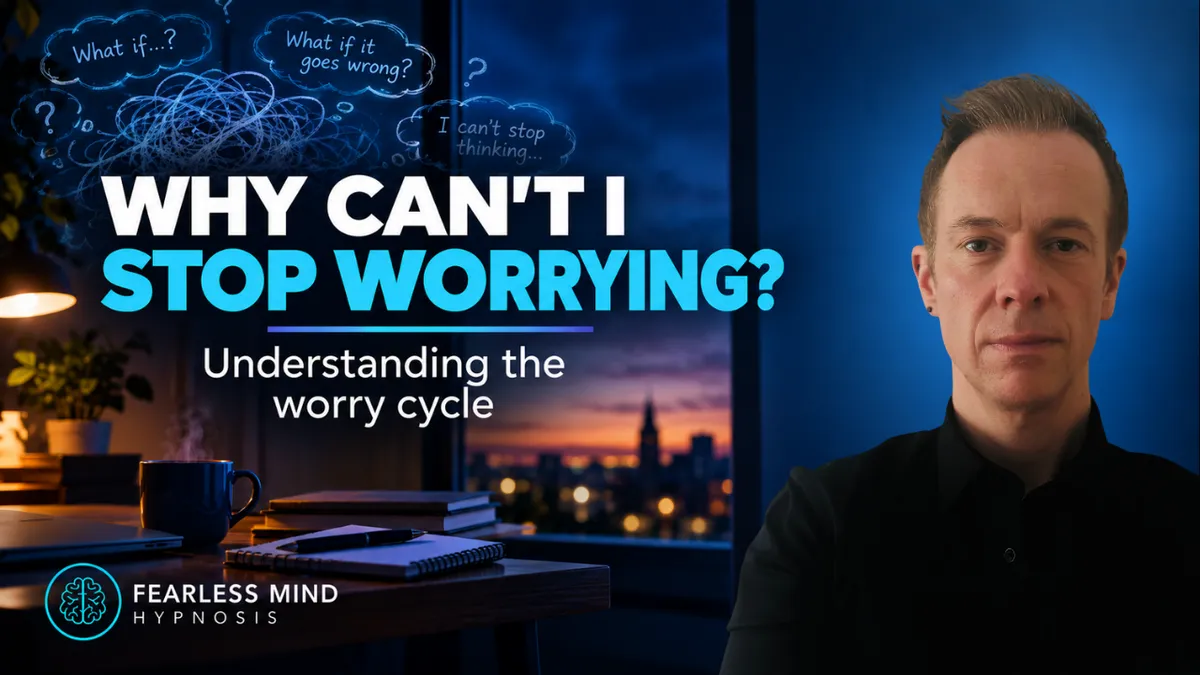
Why Can’t I Stop Worrying? Understanding the Worry Cycle
If you find yourself constantly worrying, you may already know that telling yourself to “just stop worrying” doesn’t work.
You might know you’re overthinking. You might even recognise that the thing you’re worrying about isn’t happening right now. And yet your mind keeps going:
What if something goes wrong?
What if I can’t cope? What if I’ve forgotten something?
What if I’ve made the wrong decision?
What if something happens that I haven’t thought of yet?
You think about it because you want to feel prepared. You analyse it because you want to find an answer. You run through different possibilities because you want to make sure you’re going to be okay.
But sometimes, the more you think, the more worried you become. So why is it so difficult to stop worrying?
Why Does My Mind Keep Worrying?
Worry can feel like you’re doing something useful.
When there’s a genuine problem, thinking about it can help you work out what to do. You can gather information, consider your options, make a plan and take action.
The difficulty is that anxiety doesn’t always distinguish between a problem you can actually solve and a possibility you can’t control.
For example, imagine you’ve got an important meeting tomorrow and you need to prepare for it. That’s a practical problem. You can prepare your notes, think about what you’re going to say and make sure you have everything you need.
But then your mind might move on to:
What if the meeting goes badly?
What if they ask me something I can’t answer?
What if I embarrass myself?
What if they don’t like what I say?
You can spend hours thinking about those possibilities, but that doesn’t necessarily give you any more control over what happens tomorrow.
The NHS Every Mind Matters guide to tackling worries makes a similar distinction between worries you can take action on and hypothetical worries about things that might happen in the future.
And this is where worrying can become exhausting.
Problem-Solving Isn’t The Same As Worrying
I’ve become much more aware of this distinction because I’ve experienced it myself.
Recently, I had Corporation Tax on my mind. At first, I was worrying about it. I didn’t know exactly when it was due, I didn’t know exactly how much I was going to have to pay, and because I didn’t have all the information, my mind was filling in the gaps.
Eventually, though, I stopped going round in circles and actually dealt with it.
I found out when the tax was due. I worked out roughly what I was going to owe. I looked at the numbers properly.
And something interesting happened.
I felt better.
Not because the tax had magically disappeared, but because I’d taken something vague and uncertain and turned it into something I actually understood.
That’s problem-solving. There was something I could do, so I did it.
And once I’d done what I could, continuing to run through every possible scenario wasn’t helping me any more.
That’s the distinction I think is so useful when you’re dealing with anxiety.
Problem-solving gives you something to do. Worrying often just gives your brain something else to think about.
Why Does Worrying Feel Like It Helps?
One reason worrying can be so difficult to stop is that it can create the feeling that you’re preparing yourself.
If you keep thinking about what could go wrong, perhaps you’ll be ready for it.
If you think through every possible outcome, perhaps you’ll finally find the answer that makes you feel safe.
If you keep checking, analysing or researching, perhaps you’ll eventually reach a point where you can relax.
But that point can be surprisingly difficult to reach.
There’s always another possibility. Another “what if”. Another detail you haven’t considered. Another scenario your mind could investigate.
This is one reason the NHS recommends separating practical problems from hypothetical worries, rather than treating every worry as though it requires immediate action.
The answer isn’t necessarily to never worry again. Worry is part of being human.
The more useful goal is to become better at recognising when thinking is useful and when you’ve moved into a cycle that’s no longer helping you.
What Happens When You Keep Trying To Find Certainty?
Anxiety often wants certainty.
It wants to know:
Am I going to be okay?
Will this work out?
What if something goes wrong?
Can I be absolutely sure?
But life doesn’t offer absolute certainty.
There will always be things you can’t know in advance.
If your mind has learned that you need certainty before you can relax, it can keep sending you back to the same questions. You think about the situation and feel slightly more reassured. Then another possibility appears, so you think about that. You feel temporarily better, then your mind finds another “what if”.
And the cycle starts again.
Eventually, you may not even be trying to solve the original problem anymore. You’re trying to achieve a feeling of certainty that may not be possible.
This is something I’ve had to learn about my own anxiety. I used to think that if I could just think about something enough, I’d eventually reach the point where I felt completely certain and could relax.
It doesn’t really work like that.
Sometimes the important shift is not from uncertain to certain, but from “I need to know” to “I can cope with not knowing.”
Why Trying To Stop Worrying Can Sometimes Make It Worse
There’s another frustrating part of worrying.
The more you tell yourself, “I need to stop thinking about this,” the more aware you can become of whether you’re still thinking about it.
You check: Am I still worrying?
Yes.
Why am I still worrying?
Now you’re worrying about worrying.
You might then start trying harder to get rid of the thought, reassure yourself or convince yourself that everything will be okay. Your attention remains firmly focused on the very thing you’re trying to escape.
This is why I don’t think the answer is simply learning to force your mind to stop thinking.
It’s about developing a different relationship with those thoughts.
You can notice a thought without having to solve it. You can experience uncertainty without immediately trying to remove it. You can recognise a worry without automatically following it wherever it wants to go.
So How Can You Stop Worrying So Much?
One of the simplest questions you can ask yourself is:
“Is there anything I can actually do about this right now?”
If there is, do it.
Find the information. Make the phone call. Have the conversation. Make the plan. Take the action.
But if there isn’t anything you can realistically do right now, that gives you another piece of information: continuing to think about it may not be useful.
The NHS approach to tackling worries includes identifying what you can control, making a practical plan where appropriate and recognising when a worry is hypothetical rather than something you can act on.
Another useful question is:
“Is this actually happening right now?”
If it is, deal with what’s in front of you.
If it isn’t, you may be dealing with a prediction rather than a current problem. That doesn’t mean the prediction is impossible. It simply means you don’t necessarily have to solve it today.
And pay attention to repetition.
If you’ve been thinking about exactly the same question for twenty minutes and haven’t moved any closer to a solution, that’s useful information too.
You may not need another twenty minutes.
You may need to step out of the cycle.
What If I Can’t Stop Worrying Even When I Know I’m Doing It?
This is where understanding the difference between conscious thought and automatic patterns becomes important.
You might logically understand everything I’ve described above. You might even tell yourself, “I know I’m overthinking this.”
But knowing you’re worrying doesn’t necessarily mean you can simply switch the process off.
If you’ve spent years responding to uncertainty in the same way, that response can become familiar and automatic.
A thought appears. Your attention locks onto it. You start analysing. Your body responds. You notice that response and interpret it as another reason to keep thinking.
Before you know it, you’re right back in the cycle.
That’s one of the reasons I became so interested in hypnosis.
How Can Hypnosis Help With Worrying?
Hypnosis isn’t about sitting there repeating, “I won’t worry anymore.”
It’s not about pretending that problems don’t exist, and it’s not about guaranteeing that you’ll never experience anxiety again.
For me, the interesting part of hypnosis is working with some of the automatic patterns underneath conscious thought.
The aim is to help you develop a different response.
Instead of automatically following every “what if?” thought, you can begin to create more space between the thought and what you do next.
You can learn to recognise: Is there something I need to do here?
If there is, take the appropriate action.
If there isn’t, you don’t necessarily need to keep mentally rehearsing every possible future.
There is some evidence that hypnosis can be helpful for anxiety. A 2019 meta-analysis published in the International Journal of Clinical and Experimental Hypnosis looked at 17 trials and found an overall beneficial effect on anxiety symptoms.
The evidence also suggests that hypnosis may work particularly well when combined with other psychological interventions, rather than being treated as a magic standalone solution.
That’s how I see it too.
I don’t see hypnosis as a magic way of making anxiety disappear.
I see it as one possible way of helping people change the automatic patterns that can keep anxiety and worrying going.
Hypnosis To Stop Worrying
I’ve created a short hypnosis session specifically for people who find themselves caught in this cycle.
In the session, you’ll be guided through a process designed to help you step back from the constant need to analyse, predict and find certainty.
The aim isn’t to make you stop caring. It’s to help you recognise the difference between something you need to deal with and something your anxious mind is asking you to keep thinking about.
One of the ideas I return to in the hypnosis is:
“I don’t need certainty to feel okay. I can trust myself to deal with things when I need to.”
Whatever happens, you can respond when the time comes.
Listen to the hypnosis here:
Please don’t listen while driving, operating machinery or doing anything that requires your full attention.
You Don’t Have To Solve Everything Today
If you’ve spent years worrying, it can feel as though thinking more is the way to finally reach a point where you’ll feel safe.
But sometimes the answer isn’t another hour of thinking:
Sometimes it’s action.
Sometimes it’s acceptance.
Sometimes it’s allowing yourself not to know.
And sometimes it’s simply recognising:
“I’ve done what I can for now.”
I’ve had to learn this myself.
Having anxiety doesn’t mean you’ll always be an overthinker. It doesn’t mean you’ll never be able to switch your mind off. And it doesn’t mean every uncertain situation needs to be mentally solved before you can move forward.
You can learn to respond differently.
You can learn to tolerate uncertainty.
And you can learn that you don’t have to know exactly what will happen in order to trust that you’ll be able to deal with it.
Anxiety Hypnotherapy In Glasgow And Online
I’m Andy , a hypnotherapist based in the Southside of Glasgow, specialising in anxiety, overthinking and the patterns that can keep anxiety going.
I work with people in Glasgow and online, helping them understand and change the automatic patterns that can influence how they think, feel and respond.
If anxiety is having a significant impact on your life and you’d like more personalised support, you can find out about my Anxiety Transformation Sessions.
You can also find out more about me, Fearless Mind and the other ways I help people on the Fearless Mind homepage.
Further Reading
If you’d like to explore worrying and anxiety further, the NHS Every Mind Matters resources contain practical information about managing worries and anxiety.
Mind’s information on anxiety and panic is another useful source, particularly if you’d like to understand more about how anxiety can affect thoughts, feelings and behaviour.
And if you’d like to look at the research behind hypnosis and anxiety, you can read the 2019 meta-analysis on PubMed.